Showing posts with label pennsylvania folklore. Show all posts

Monday, January 20, 2025

Hexeglaawe: Bloody Mary

There is much debate on the origins of the folklore ritual which attempts to invoke the appearance of Bloody Mary.  While staring into a mirror in a dark, candle-lit room, say her name three times and she will appear.  Descriptions vary, though typically she is described as being a corpse, a witch, or a ghostly form - often covered in blood.  

A number of historical figures have been cited as the possible source, including Mary I of England, who put to death over 300 Protestant dissenters during her reign in the 1500's.  In the 17th century, Elizabeth Bathory, a Hungarian countess, allegedly tortured and killed over 600 young women, bathing in their blood to keep herself young. On American soil, Mary Worth is a strong contender for the legend.  She was rumored to have killed slaves escaping the South via the Underground Railroad.  

Pennsylvania has its own tale, offering another origin for Bloody Mary.  Her name was Mary Gansmueller.  In the late 1700's, in a village in Lancaster County, children began to disappear.  An investigation led to Mary's small cottage in a wooded area nearby.  Mary was an elderly woman who sold herbal remedies to the surrounding villages.  During the search, townspeople noticed her appearance had changed - she was now much younger.  Unmarked graves were discovered in the surrounding woods.  She had murdered the children and used their blood to regain her youth.  

She was dragged from her home and burned at the stake.  Before her death, she screamed a curse from the flames.  If anyone mentioned her name before a mirror, she would avenge herself upon them.


Despite the nebulous origins of the urban legend, it's a genuinely spooky concept.  Once, when I was very young, my sister must have learned of Bloody Mary and wanted to see if she was the real deal.  With a keen sense of self preservation, she placed ME into our family's upstairs bathroom, lit a candle, turned out the lights, and forced me to call to Miss Bloody Mary.  I was horrified and truly believed I was about to see some horrid ghost in the mirror.  I said her name three times. 
Bloody Mary
Bloody Mary
Bloody Mary 

Thankfully, no one showed up.  

My sister was extremely disappointed.  


Monday, December 30, 2024

Hexeglaawe: River Witches

While most people think of Salem as the home of Witchcraft in America, Pennsylvania has a rich, but lesser-known history of Witch folklore.  Most notable is Emma Knopp (also known as Nellie Noll) - the River Witch of Marietta.  In 1928, her instructions to break a curse placed upon John Blymire resulted in Blymire and two accomplices committing the murder of Nelson Rehmeyer.  

In Fayette County, Mary “Moll” Derry, the Witch of Monongahela, was believed to have the ability to fly, and her curses could cause the death of anyone who crossed her.  Rattlesnakes were said to guard the door to her home along the Monongahela River.

In a wooded area by Ridley Creek, at the edge of the Delaware River in Eddystone Township, the Legend of the Witch of Ridley Creek is told.  Accused of causing sickness and death of local livestock and appearing to witnesses in ghostly form, Margaret Mattson stood trial for her crimes in 1683.  Thanks to the involvement of the colony's proprietor William Penn, Mattson was found guilty of having the reputation of a witch, but not guilty of bewitching animals, and was released.  A popular legend tells of William Penn dismissing the charges against Mattson by affirming her legal right to fly on a broomstick, saying "Well, I know of no law against it."

Pennsylvania's colony was founded on religious tolerance, and accusations of Witchcraft were treated far differently than in Salem, Massachusetts.  This tolerance may have made the Commonwealth a haven for those who practiced, leading to a surge in strange sightings and occurrences, with many still being reported even today.  


Tuesday, April 30, 2024

Hexeglaawe: Hexenkopf Rock


Pennsylvania Dutch settlers called this place Hexenkopf  (witch's head) due to an outcrop of rock resembling the profile of a witch.  Sometimes it's called Misery Mountain or Haunted Hill by the locals.  There are tales of unholy shrieks, evil spirits, and an eerie glow in the moonlight (due possibly to large deposits of mica embedded in the rock).

Lenape Native Americans used this rock as a site for rituals intended to take evil and sickness from the body. Later, immigrants continued this practice.  Local pow-wow doctors used Hexenkopf Rock as a place to transfer sickness, curses, and spells.  For two centuries, misery was deposited into this rocky landscape.

Similar to Mount Brocken in Germany, witches are said to congregate here on the night of April 30th, Walpurgisnacht.  


Monday, January 15, 2024

Hexeglaawe: Frick's Lock

Our latest expedition to explore Pennsylvania's forgotten places took us to the ghost town of Frick's Lock.  Located in Chester County, PA, it dates back to the 18th century when it was a thriving village thanks to the commercial traffic of the Schuylkill Canal.  By the 1880's, the railway systems dominated the networks of canals and the importance of Frick's Lock diminished.  The canals were ultimately abandoned and drained in the 1920's, and isolated farms remained.

In 1969, the Philadelphia Electric Company began building the Limerick Nuclear Power Station directly across the river from Frick's Lock.  The station went live in 1986 and conflicting accounts suggest that residents were either bought out and relocated or given a 48-hour notice forced evacuation.  The town was left completely abandoned...or so we were told.

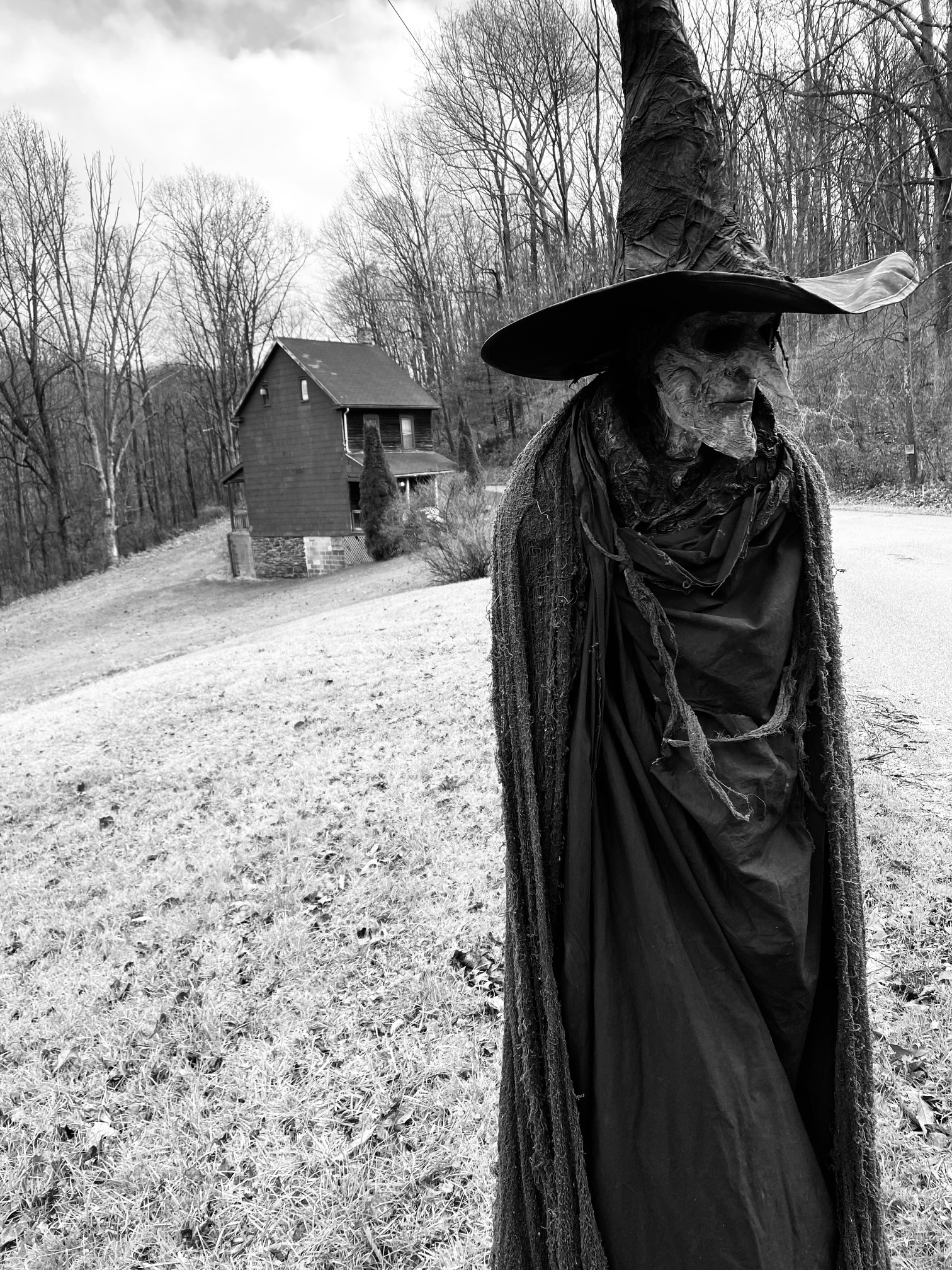
Our urban exploration of the village revealed strange noises and a strong feeling of being observed.  As we made our way back to the car, we spotted a small clearing near one of the larger houses.  Standing in a field was a scarecrow.  Before getting a chance to investigate any closer, a large rock was thrown in our direction.  Our expedition was cut short, but not before we snapped a few photos.


Friday, November 3, 2023

Hexeglaawe: The Witch's Chair

The latest investigation for our Hexeglaawe Pennsylvania folklore series led us to the St. James Episcopal Church in Bristol, PA.  Behind the Church you will find a small iron chair near the grave of Merritt P. Wright (1860-1911).  Little is known about her, but the local legend claims Merritt was a witch.  According to the legend, if you go to the graveyard and sit in the chair at midnight during the month of October, you will feel the cold hands of the witch.  Curiously, there were fake cobwebs stretched over the chair and a small twig witch broom to the right of it.  This seemed to indicate the community, and the Church, embrace (or allow) the legend to continue.  We didn't wait around until midnight, since it was November, but we definitely plan to head back next October to see if the legend is true.


Monday, March 6, 2023

Hexeglaawe: The Mummy Ghost

Perhaps the strangest tale we researched for our Hexeglaawe Folklore Series was that of a mummified ghost haunting Chickies Rock.  According to the story, it was 1946 and a group of friends were enjoying the beautiful view from an overlook high above the Susquehanna River.  At some point, they realized they had forgotten to bring water, so a few of them left to retrieve it.  It was then that they saw a terrifying creature.  Described as having no visible arms or legs and being wrapped in old, tattered bandages, the entity towered above them at a reported height of sixteen feet.  As if the description above wasn't peculiar enough, they mentioned that six knives were protruding from the creature's head.

We scaled the rocky terrain of Chickies Rock again in the hopes of seeing such a monster, imagining what it must have been like all those decades ago.  As we looked out over the winding river from those quartz-filled cliffs, the cold biting wind was impressive through the leafless trees, and it forced us to cut the expedition short.  As we headed for the car, we hoped to be startled by the towering Mummy Ghost.  Except for the creaking trees swaying in the heavy wind, we heard and saw nothing.

We ducked into a local tavern to warm up and had a very interesting conversation with an elderly man sitting at the end of the bar.  We told him we were researching the Legend of the Mummy Ghost and he was quite delighted to set us straight.  He told us the name of the initial witness:  Harriet Horn.  He then said, "They weren't knives.  They were arrows." and added "And they weren't in its head."

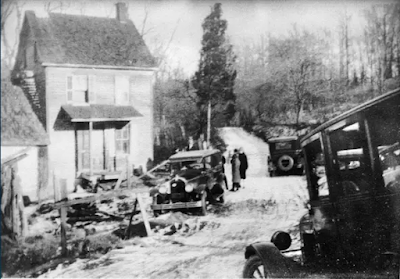
He then reached into his wallet and revealed the below photograph.


Wednesday, December 21, 2022

Hexeglaawe: Belsnickel

In the wake of popular American interest in European Krampus traditions, few Pennsylvanians are aware that the commonwealth is the New World point of origin of an equally legendary and fearsome figure known to the Pennsylvania Dutch as the Belsnickel.

Although interpretations of the Belsnickel have varied considerably throughout Pennsylvania, many Berks County families remember a time when the tap-tap-tapping of the Belsnickel’s birch switches against the window was a foreshadowing to the children of what was to come. Clad in furs, smeared in soot, and waving a bundle of birch switches, the Belsnickel served as both bearer of gifts and the agent of punishment in the Pennsylvania Dutch Christmas tradition. The Belsnickel typically was masked and dressed in patched and tattered clothes, sometimes carrying a whip or crowned with horns.


Monday, December 5, 2022

Hexeglaawe: Rehmeyer's Hollow

In 1928, after years of bad luck, John Blymire believed that he had been cursed, or hexed, by a local folk healer named Nelson Rehmeyer, who practiced pow-wow or Braucheri (Pennsylvania Dutch folk magic). The source of Blymire’s hex was confirmed by another powerful local healer, Nellie Noll - the River Witch of Marietta. To break the curse, she instructed Blymire to obtain a lock of Rehmeyer’s hair and his spell book and bury them six feet underground.  In November of 1928, Blymire, along with two accomplices, broke into Rehmeyer's home.  A confrontation ensued, ending in Rehmeyer's death. The three men charged with the crime then set fire to the house, hoping to remove the curse and to destroy evidence of the murder.  However, the house did not burn down as they had hoped.  This reinforced the belief that Rehmeyer was a witch and that his power prevented the destruction of the house. 

Rehmeyer's home, where he was murdered, still stands on Rehmeyers Hollow Road. The area has now come to be known as Hex Hollow.  Many locals believe it to be haunted.


This is the first entry in a series of blog posts investigating the folklore of Pennsylvania.  Hexeglaawe (the PA Dutch word for 'superstition') will hopefully reveal photographic evidence of rural legends, hauntings, folklore, and roads less traveled.

Thanks, Wren, for this neat idea and project.  I have a feeling we're just gonna find some monsters out there.

More information here.